

Drive to Zero’s Brazil Lead Isabela de Siqueira participated in a series of events at São Paulo Climate Week and the ESG Supply Summit with top level government officials and industry leaders, including:
- Aloisio Melo, National Secretary for Climate Change, Ministry of the Environment and Climate Change (MMA)
- Danilo Perecin, Director of Energy, São Paulo State Secretariat of Environment, Infrastructure, and Logistics
- Thiago Casagrande, Senior Environmental Engineer, Ministry of Transportation (MT)
- Saori Yano, Head of Sustainability for Brazil Operations, Amazon
- Priscila Rocha, Head of Sustainability, Volkswagen Truck & Bus
- Gustavo Bonini, Director of Institutional Relations, Scania
- Matheus Baraúna, Vale’s Senior Investment Officer for Decarbonization Projects
- Approx. 40 members of the e-Dutra coalition.
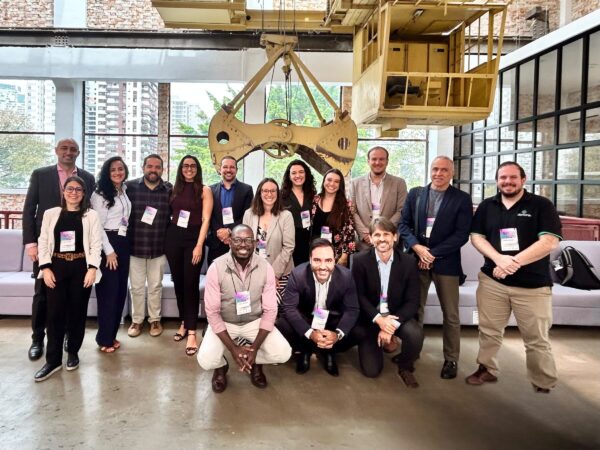
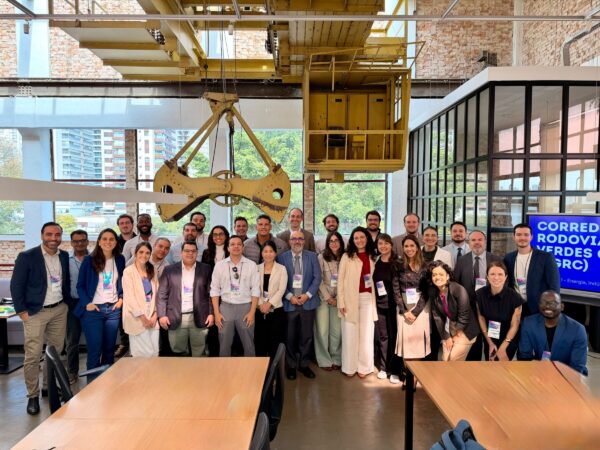
The goal: Accelerate Global MOU signatory Brazil’s transition to ZE-MHDVs. Key takeaways from each event:
SPCW—Government-Business Dialogue and Fleet Electrification as Industrial Policy
- Fleet electrification is not only a decarbonization strategy, but also an industrial and economic opportunity for Brazil, with potential to strengthen domestic production, attract investment, and develop new value chains.
- Subnational governments have a critical role in creating the conditions for deployment through energy planning, public procurement, concessions, tax incentives, and mechanisms such as differentiated tolls.
- Scaling electrification requires looking beyond the vehicle: charging infrastructure, grid availability, vehicle weight regulations, financing, and long-term investment certainty need to advance together.
- Stronger public-private coordination is essential to translate corporate demand and public policy objectives into deployment at scale.
SPCW—Global Green Road Corridors (GGRC): The e-Dutra Experience
- The discussion reinforced the need to move from ambition to coordinated implementation, bringing government, industry, freight operators, shippers, infrastructure providers, and other stakeholders together.
- Green freight corridors provide a practical framework to coordinate the different pieces of the transition — vehicles, charging infrastructure, energy, policy, and business models — around a specific geography.
- The e-Dutra Coalition is an example of this approach in practice, bringing together actors around concrete deliverables and implementation opportunities rather than isolated commitments.
- The next phase requires maintaining this collective approach while translating it into tangible projects, infrastructure planning, pilots, and enabling policy and financing conditions.
ESG Supply Summit— Panel: Transition in the Energy, Industrial, and Transportation Sectors
- Across industry, energy, and transport, sustainability is increasingly an economic competitiveness and long-term business strategy, rather than a standalone environmental agenda.
- The challenge now is scale: companies are already implementing solutions, but broader deployment depends on enabling a regulatory and financial environment.
- Carbon market regulation can become an important mechanism for providing economic signals and mobilizing investment toward lower-carbon solutions.
- Financial instruments, including Brazil’s Climate Fund, are critical to reducing investment barriers and supporting the transition from pilots to larger-scale deployment.
- The discussion reinforced that the transition requires alignment between corporate investment, public policy, regulation, and finance to create the conditions for sustained market transformation