
The true foundation for a global zero-emission freight sector — e-truck and bus charging infrastructure — is scaling rapidly. We have less than 14 years to accomplish a massive technological shift, meet manufacturing and fleet electrification goals, and reach our global emissions goals. Governments are investing, working across borders, and collaborating with the private sector to build the needed infrastructure. We are seeing a clear shift from pilot projects to industrial-scale deployment globally and ensuring a successful shift means making sure that trucks can recharge on the global corridors that move goods from ports to cities, and from country-to-country.
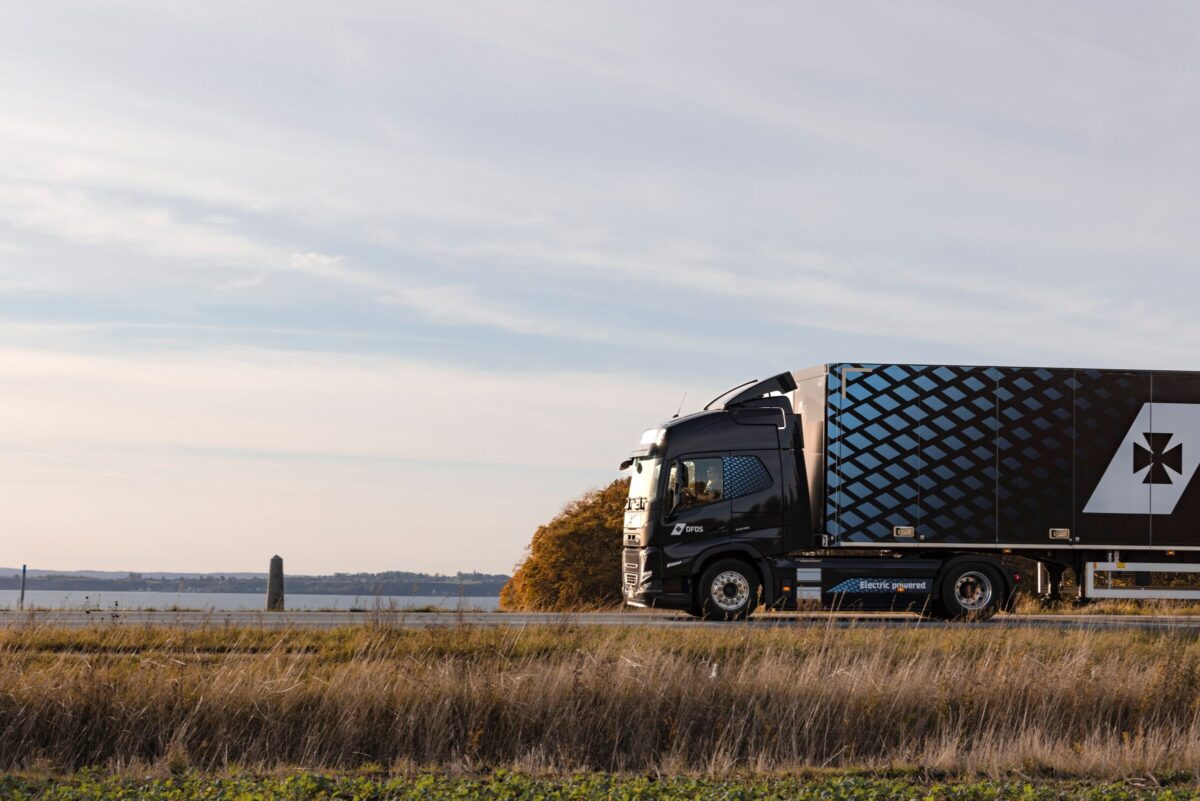
Photo: DFDS zero-emission truck on the road in the United Kingdom.
In North America and with the support of industry innovators, the governments of California, Oregon, Washington, Baja (California), and British Columbia will soon formalize a collaborative effort to seamlessly power zero-emission trucks and buses on the I-5 from British Columbia, Canada to Baja, California through the BC2BC Green Corridor (learn more about this effort below). In Latin America, a soon-to-be-announced 1,200km corridor in Colombia will make zero-emission freight a reality from Bogotá–to-Barranquilla–to-Cartagena. These projects represent two additional corridors that are a part of the Global Green Corridors Initiative supported by CALSTART’s Drive to Zero.
In Europe, the Clean Transport Corridor Initiative is supported by nine European countries (Belgium, Denmark, Germany, Lithuania, Malta, Netherlands, Austria, Poland, and Sweden) and will result in heavy-duty electric vehicle charging infrastructure along the Scandinavian-Mediterranean and North Sea-Baltic freight corridors. On the investment front in Europe, Germany just announced a one billion-euro funding program to support the development of charging infrastructure for battery-electric heavy-duty commercial vehicles.
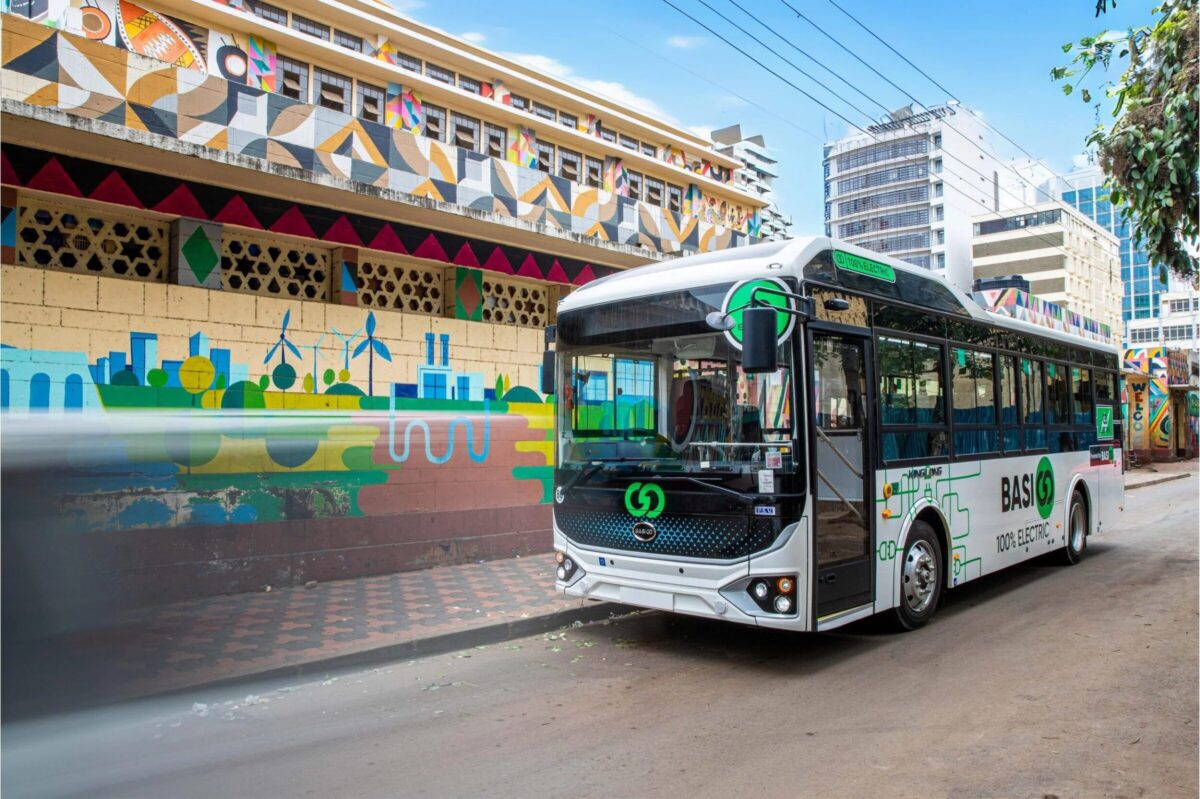
Photo: BasiGo zero-emission bus on the road.
As zero-emission commercial vehicle charging becomes a part of the landscape of our global corridors, we will continue to see the business case for zero-emission commercial vehicles improve. Knowing that charging is reliable, efficient, and available will encourage more zero-emission commercial vehicle purchases, more manufacturing, more efficient supply chains, increased competition, and ultimately lower sticker prices.
Zero-emission trucks and buses — and the infrastructure that powers them — are real-world economic, energy security, jobs, and clean air solutions that companies and communities around the world are using and relying on now. Let’s keep going!
— The Drive to Zero team
Special Features
🌎 Welcome to Our New Global MOU Endorsers!
|
|
|
 |
|
|
|
 |




🌎 Drive to Zero at the ITF Summit 2026
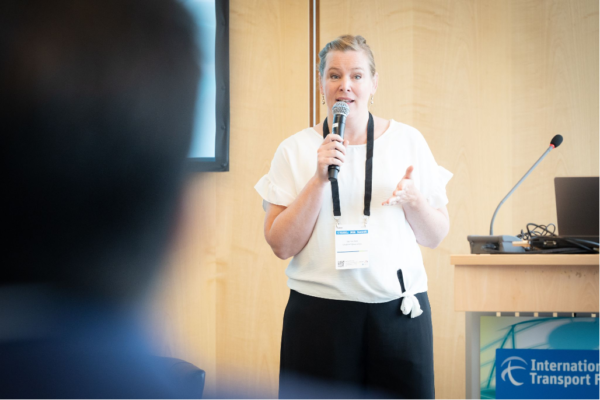
Photo: CALSTART’s Drive to Zero Europe Director Sita Holtslag at the ITF Summit 2026.
Senior government officials and transportation innovators from around the world came together at the ITF Summit in Leipzig, Germany to discuss the urgent need to transition to zero-emission medium- and heavy-duty vehicles now because of the economic and energy security benefits during the session Energy Resilience on Wheels, Scaling Zero-Emission Transport:
- The government of Colombia, co-lead of the Global MOU, emphasized the country’s commitment to achieving 100% new zero-emission truck and bus sales by 2040.
- Dmitry Mariyasin, Deputy Executive Secretary, United Nations Economic Commission for Europe, discussed the potential of vehicle to grid and the importance of standardization to support market deployment at scale.
- Top industry expert Doris Martetschlaeger from IKEA spoke about how resilience makes the business case for ZE-MHDVs — intermodality and electrification help reduce exposure to fuel price volatility and strengthen energy security.
- Sophie Punte, representing Milence, spotlighted how charging infrastructure is not only decarbonisation infrastructure; it is resilience infrastructure. Additionally, she explained how long-term public charging becomes a cornerstone of Europe’s economic and strategic resilience in three ways.
- Karol Gobczynski of TRATON GROUP highlighted the swift scaling up of production of zero-emission trucks and highlighted that in times of transformation and uncertainty, there is always a temptation to wait. But today, he says, the biggest risk is not acting.

Photo: Energy Resilience on Wheels: Scaling Zero-Emission Transport” at the ITF Summit 2026.
The event was co-led by CALSTART’s Drive to Zero, the Accelerating to Zero Coalition, the Climate Group, ICCT, and World Business Council for Sustainable Development.
Interested in attending future Drive to Zero events? Follow us on LinkedIn to receive our event updates.
🇬🇧 GRIDSERVE is Charging Up Change in the UK

A major initiative is underway to ensure the charging infrastructure exists to support the UK’s goal of achieving 100% new electric heavy goods vehicle (eHGV) sales by 2040. Charging company GRIDSERVE is building the nation’s first charging network for battery electric HGVs. The Electric Freightway will consist of 200 chargers and have the ability to service around 140 eHGVs. The infrastructure provided will be powered by 100% net zero energy. Supporting the UK’s clean transportation transition with zero-emission energy—now that’s Charging Up Change!
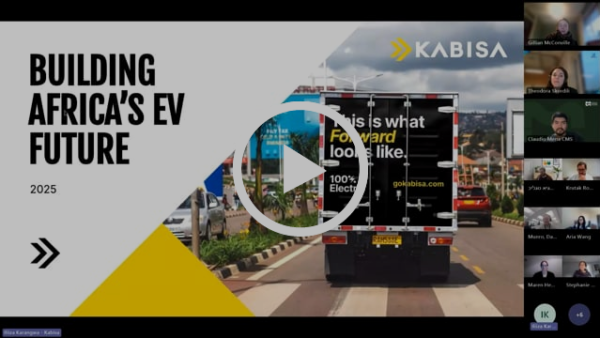
🇪🇹 Global MOU Community Success Story: Kabisa’s #RoadtoAddis
Kabisa, an EV supplier dedicated to building East Africa’s largest e-mobility system, has turned a dream into reality. As part of a project called #RoadtoAddis, they tested whether their electric Farizon H9E truck—which has a 4.5 tonnes payload with up to 8 tonnes capacity—could truly handle East African terrains and sustain a 1,677kM trip from Nairobi, Kenya to Addis, Ethiopia. Not only was the 9-day trip a success, it demonstrated significant cost savings.The cost to fuel each truck was only $180 compared to $540 for a diesel truck equivalent. Overall, Kabisa estimates the trucks delivered up to 70-80% lower OPEX vs. diesel—talk about a success story and proof that zero-emission trucks are available, advanced, and affordable!
🇨🇴 2026 Value Chain Decarbonization Forum in Bogota, Colombia
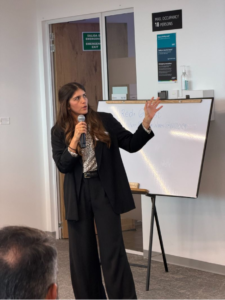
Photo: Drive to Zero’s Maria Paulina Martinez presents at the 2026 Value Chain Decarbonization Forum in Bogota, Colombia.
Drive to Zero’s Maria Paulina Martinez Mendez recently shared her expertise at the 2026 Value Chain Decarbonization Forum in Bogota, Colombia about the global transition to zero-emission trucks and buses. Key insights included:
✅ In Colombia, there are more than 25 electric freight models available for purchase, with leading models reaching up to 420 km of range, signaling a market nearing maturity.
✅ Electric truck sales grew by 800% between 2022 and the first half of 2025 globally.
✅ Global fleets see the value of transitioning to zero. Mexico’s Grupo Modelo S.A. de C.V., in partnership with Element Fleet Management and Global MOU endorser MegaFlux Fleet Electrification Solutions, launched an electric truck fleet in 2022, with an expected 3% reduction in total cost of ownership compared to diesel costs.
The Forum was hosted by LOGYCA, in partnership with ANDI – Asociación Nacional de Empresarios de Colombia, COLFECAR, and Defencarga— thank you for hosting such a great event! Drive to Zero was honored to participate and looks forward to our ongoing work together to change transportation for good!

Photo: Drive to Zero’s Maria Paulina Martinez workshops with colleagues at the 2026 Value Chain Decarbonization Forum in Bogota, Colombia.
🚛 Endorser Spotlight: Milence Announces €120 Million Financing Facility for Truck Charging in Europe

Global MOU endorser Milence, announced a €120 million financing facility to further support the deployment of truck-dedicated charging hubs across Europe. With 34 charging hubs live and 16 under development across nine European countries, Milence operates one of the largest public charging networks dedicated to heavy‑duty trucks. The new facility will enable new charging hubs along key freight corridors, expand capacity at existing sites, and support the roll out of a high‑performance Megawatt Charging System (MCS).
Upcoming Events
🗓️ California, British Columbia, Oregon, Washington, and Baja to Launch Zero-Emission Charging Network for Trucks Spanning the West Coast
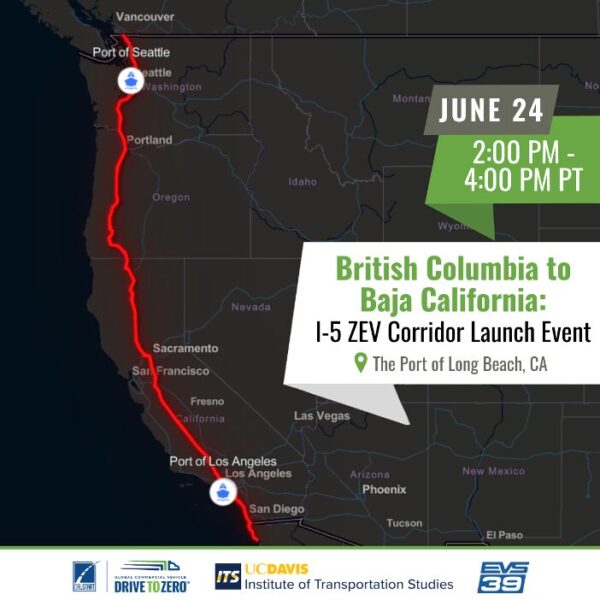
Mark your calendars! CalSTA, CALSTART’s Drive to Zero, and University of California, Davis will help launch the “BC2BC ZEV Corridor initiative” to seamlessly power e-trucks and e-buses on I-5 from British Columbia to Baja, California. With the support of industry innovators, public officials from State and Provincial Departments of Transportation in California, Oregon, Washington, Baja California, and British Columbia will lead a signing ceremony and zero-emission truck showcase at the Port of Long Beach. Officials will commit to collaboratively harmonizing the technologies along the route as well as the planning to ensure the project’s success.
Questions? Contact Drive to Zero Project Manager Owen MacDonnell (omacdonnell@calstart.org).

Mobility Portal Media Opportunities—Inquire Today!
Drive to Zero is proud to partner with Mobility Portal to provide key insights on the global transition to zero-emission trucks and buses. Interested in contributing your expertise or sharing your story as part of this collaboration? Contact Ricardo Garcia at rgarciacoyne@calstart.org to learn more.
Top Headlines

Market
- The Results Are In: 93% of Electric Truck Owners Say They’re Not Going Back
- Zenobē and Winnings Announce New Electric Trucks Partnership
Fleet Deployments
- €14 Million Investment To Bring 40 New Electric Buses And Self-Driving Shuttle Trials To Malta
- SANY is Delivering Electric Trucks to Indonesia
- Einride, EASE Logistics, DriveOhio, and INDOT Announce Deployment of Autonomous Electric Trucks
- Go-Ahead London Takes 13 Electric Alexander Dennis Enviro100EV for Crystal Palace–Clapham route
- 500 Electric Buses and Counting. BYD Hits a Major Milestone in Japan
- Electric Vehicles Continue Their Success Story: More than 100 MAN e-buses for Vilnius in Lithuania
- Limoges Orders 33 to 85 Electric Buses from Iveco Bus for TCL Network Electrification
- Frankfurt Expands Commercial EV Fleet with 10 New Vocational Trucks
- WattEV Orders CA-record 370 Tesla Semis in CV Leasing Play
Manufacturers and Models: Trucks and Buses
- Scania and Unicon Demonstrate Fully Electric Concrete Transport in Real-World Operations
- World Premiere for the MAN eTGM at Transpotec
- Tesla Semi Battery Specs Officially Revealed in CARB Filing, Confirming 822 kWh Long-Range Pack
- Toyota Announces Strategic Collaboration with Hyroad to Deploy Hydrogen Fuel Cell Trucks
- Humble Robotics Has Developed a Cab-less Autonomous Electric Truck for Ports, Railyards, and Warehouses
- TRATON €850M Green Bond & Loan for EV Trucks
- Solaris Selects Ballard’s FCmove®‑SC Engine to Power its Next‑Generation Hydrogen Bus PlatformDAF Starts Production of XG Electric and XG⁺ Electric
Government Policies
- UK Strips HGV Rules from Electric LCVs, Adoption Target Looms
- Washington Zero-Emission Incentive Program Launches April 29
Financial Incentives
Fuels and Infrastructure
- Germany Announces One Billion Euros for the Development of Charging Infrastructure for Heavy-Duty Vehicles
- Milence Secures €120 Million Financing Facility to Further Scale the Rollout of Electric Truck Charging Infrastructure Across Europe