
Some of the most effective tools for lowering the cost of zero-emission trucks and buses are not new technologies. They are smart policies. Around the world, countries are adopting supply-side regulations and other industrial policies, as well as market-based measures that reduce operating costs, provide investment certainty, and accelerate deployment. While zero-emission medium- and heavy-duty vehicles (ZE-MHDVs) already deliver strong economics in many markets and applications, well-designed policy packages can further reduce costs, accelerate deployment, strengthen supply chains, and attract private investment. This edition highlights proven policy approaches that are helping fleets save money today while sending clear signals to manufacturers and investors to expand the zero-emission bus and freight market.
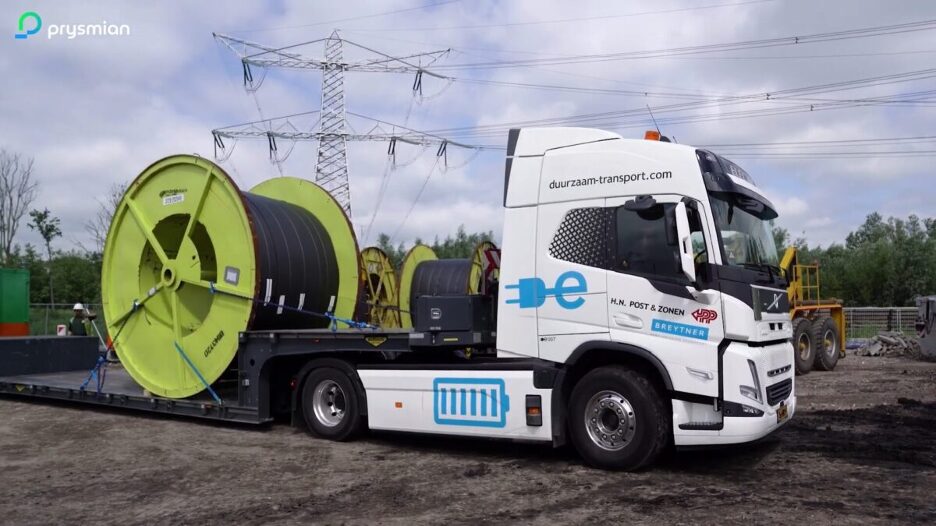
Photo: Leading cable manufacturer Prysmian Netherlands is Charging Up Change by piloting zero-emission heavy-duty trucks in its operations.
Recently, CALSTART’s Drive to Zero program—working strategically to provide multi-stakeholder engagement, technical, and analytical support—brought together government experts from across Europe to advance the Eurovignette Directive. The Directive demonstrates how smart policy can reduce costs, strengthen the business case for zero-emission trucks, and accelerate market adoption through toll exemptions for zero-emission trucks and CO₂-based road charging for heavy goods vehicles (HGVs).
Representatives from countries including Austria, Denmark, The Netherlands, Norway, and Switzerland shared their approach to the Eurovignette —and industry leaders such as sennder, Geopost, and the European Automobile Manufacturers’ Association expressed their support for these programs.
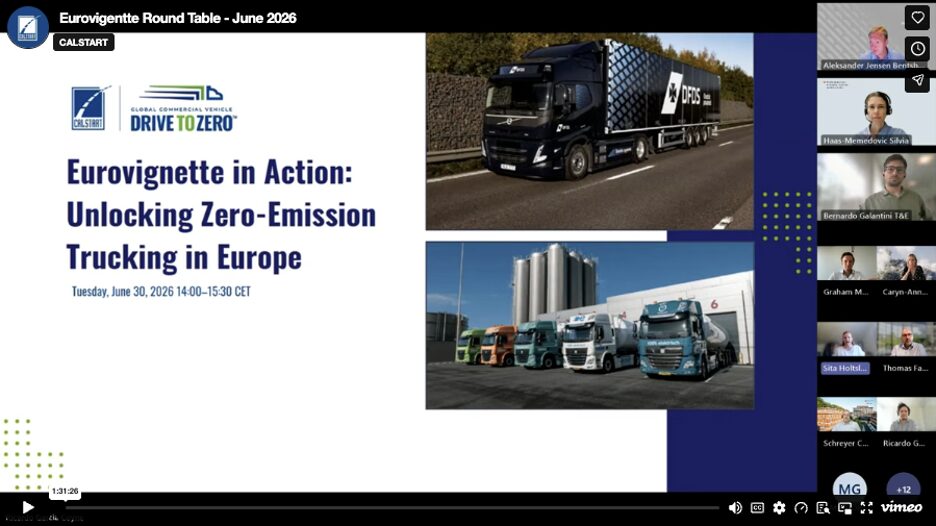
Watch the Eurovignette in Action: Unlocking Zero-Emission Trucking in Europe event here.
Industry experts were unified in their stance that volatile fuel prices in Europe expose the road transport sector and broader economy to ongoing cost shocks. One of the most immediate tools available to EU Member States to address this uncertainty, they say, is the implementation of toll exemptions for zero-emission trucks under the Eurovignette Directive.
Theirs is a message echoed in a letter 58 companies sent to EU Member States in April. The coalition of major European businesses is calling on Ministers across the EU to swiftly implement toll exemptions for zero-emission trucks (ZETs), describing them as “crucial” for Europe to maintain its industrial leadership in the freight sector. They add that “implementing this measure, alongside CO₂-based truck tolling, is vital to reduce operating costs and enable European companies to deploy ZETs at scale.”
In Germany, which has adopted a full road toll exemption and CO2-based road charge of 0.158 EUR/km, the TCO of battery electric trucks (BETs) is cheaper than diesel across all years and segments. This is according to research from our partners at The International Council on Clean Transportation. The Netherlands, which just began implementing its own Eurovignette Directive, will use the revenues it collects from truck tolls to help fund subsidies for ZETs. These subsidies will help the country accelerate ZET adoptions to the point that one-in six-trucks will be zero-emission by 2030—a 30% increase from today.
Governments in South and Southeast Asia, Africa, and South America are also finding innovative ways to lower the cost of operating zero-emission trucks and buses.
- In India, a ~US$1 billion fleet modernisation scheme in the National Capital Region combines interest-rate subsidies, OEM discounts, fuel vouchers, and registration and motor vehicle tax exemptions for up to 10 years to accelerate ~200,000 fleet replacements (learn more about India’s ZET innovations in our Charging Up Change video).
- In Vietnam, battery electric vehicles benefit from registration fee exemptions, and reduced vehicle taxes, helping lower the upfront costs for zero-emission transport.
- In Chile, battery electric vehicles receive a 100% exemption from the annual circulation (registration) tax for the first two years, followed by a phased payment.
- In Brazil, several states provide partial or full exemptions from the annual motor vehicle ownership tax for electric vehicles (learn more about Brazil’s ZET innovations in our Charging Up Change video).
- Kenya has implemented target tax incentives—including a 0% consumption tax—on electric buses and other electric vehicles.
Because many governments face competing budget priorities and limited resources for direct incentives, policy measures are often among the most practical and effective tools for accelerating the transition to zero-emission medium- and heavy-duty vehicles. Toll exemptions, CO2-based road charging, registration fee waivers, and tax exemptions serve as proven solutions. What’s more, these approaches have strong industry support. Drive to Zero will continue supporting governments around the world in identifying and advancing the policy approaches that best fit their needs to accelerate the deployment of affordable zero-emission trucks and buses, while sending clear market signals, and unlocking private investment.
— Stephanie Kodish, Senior Global Director, CALSTART’s Drive to Zero
Special Features
📣 IT’S OFFICIAL! 300!
More than 300 top companies, subnational governments, and organizations have officially endorsed the Global Memorandum of Understanding on Zero-Emission Medium- and Heavy-Duty Vehicles (Global MOU), which aims for 100% new zero-emission truck and bus sales by 2040 with an interim goal of 30% new sales by 2030. Global MOU signatory nations now represent 44% of the world’s GDP and endorsers $7.26T in 2025 revenue alone.

Global MOU endorsers:
- Include some of the largest and most innovative brands in the world including BYD, ChargePoint, DHL, Heineken, Lion, Rivian, Scania, Siemens, Windrose, Workhorse, and many more!
- Are headquartered in London, Delhi, Amsterdam, Santiago, Sydney, Warsaw, New York City, Mexico City, Hong Kong, Bogotá, Brussels, San Francisco, São Paulo, Madrid, Nairobi, and many more!
- Know the value of zero-emission trucks & buses because they make them, use them, power them, and they want more of them!
Welcome to our newest endorsers who helped us achieve the 300 endorsers mark! Let’s celebrate Camber Charging, Clean Technology Training Trust, Conecta Logistica, Elenway, Green Worldwide Shipping, Hapag-Lloyd AG, Juleh Mobility Private Ltd., Tanzania Electric Mobility Association (TAEMA), Vemo, and Zero Emission Motors.
|
|
|
 |
|
|
|
 |



|
|
|
 |
 |


Join them — endorse the Global MOU today!
🗓️ BC2BC Launch Event

On August 26 from 10am—4pm local time, California, British Columbia, Oregon, Washington, and Baja California governments will launch the BC2BC Corridor, an advanced technology zero-emission charging network for trucks and buses along the I-5. The corridor will make it possible for electric heavy-duty vehicles to charge and drive from British Columbia, Canada to Baja California, Mexico.
Don’t miss:
- Special government announcements
- Zero-emission truck showcase at the Port of Long Beach
- Expert workshop discussion
The public is welcome to the launch at Long Beach Civic Center Plaza | 411 W. Ocean Blvd, Long Beach, CA 90802. This event is organized by CalSTA, CALSTART/Drive to Zero, Port of Long Beach, and the UC Davis Institute of Transportation Studies and hosted by the Port of Long Beach.
Welcome to the Team, Rocio Ruelas!
We are pleased to announce that Rocio Ruelas has joined our team as Drive to Zero program coordinator. Rocio works at the intersection of sustainable transport, climate action, and international collaboration. Drawing on experience in public sector leadership, international organizations, and applied research, she has partnered with governments and local stakeholders across Latin America to advance transport electrification, public transport digitalization, urban resilience, and climate planning. She brings together policy, stakeholder engagement, and implementation to help turn ambitious ideas into practical action. Most recently, as an Alexander von Humboldt International Climate Protection Fellow in Germany, she researched integrating climate action into urban mobility planning while strengthening knowledge exchange between the Global North and Global South. She is committed to advancing collaborative approaches that accelerate the transition to zero-emission transport and support more inclusive mobility systems. Rocio is based in Mexico.
🇳🇿 New Zealand Adopts Zero-Emission Vehicle Cost Saving Measure
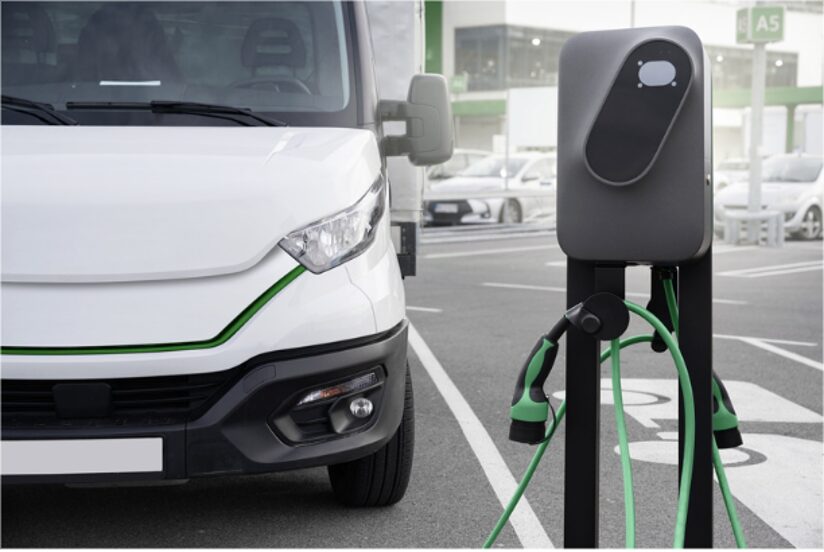
Earlier this month, New Zealand formalized regulations to allow electric vans and small electric trucks to be driven on a car license. “The Government has also agreed to permanently allow Class 1 licence holders to drive heavier zero-emission vehicles up to 7,500kg.” This regulatory action will help lower the commercial barriers for fleets to go electric. They can now carry just as much cargo as their diesel counterparts without needing to have a more expensive professional heavy vehicle license.
🎥 Video: Major Electric Truck Charging Hub in U.S.
CALSTART member EV Realty has launched a major electric truck charging hub in California’s Inland Empire, which is along one of the busiest freight routes in the Western United States. The 9-MW project is equipped with 76 charging stations and is designed to support more than 200 medium- and heavy-duty trucks per day.
CleanTrucking published a video with more details about this innovative project. The video includes interviews with EV Realty’s Chief Commercial Officer, Suncheth Bhat, and Nevoya CEO and co-founder, Sami Khan. Nevoya’s AI-powered all-electric fleet uses the charging hub every day.
🇨🇷 Charging Up Change in Costa Rica’s Agricultural Sector
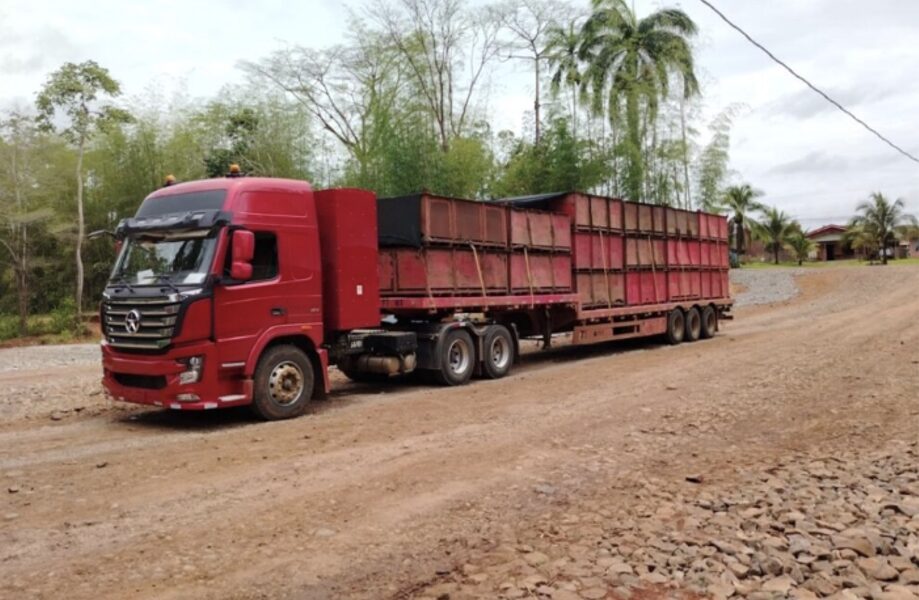
Costa Rica’s agricultural sector, led by the sugarcane industry, is charging up change by transitioning to 100% electric heavy duty truck tractors. How sweet is that?!?
Global MOU signatory Costa Rica’s first commercial deployment of 100% electric heavy-duty truck tractors began with CABUS importing 6 electric truck tractors for sugar mill Ingenio Cutris in San Carlos. The trucks were assigned to transport sugarcane between farms and the mill in Boca de Arenal, demonstrating that electric heavy-duty freight can operate in rural, productive and demanding conditions, not only in urban delivery routes.
Since then, CABUS has imported 11 other zero-emission truck tractors in Costa Rica. Operators report around 80% savings when comparing fuel expenditure against electricity (before maintenance savings).
The sugar cane industry’s deployment is the anchor case: It proved the operational feasibility of heavy-duty electrification in an agricultural corridor, reduced noise and exhaust exposure around Boca de Arenal, and created evidence for replication in other Costa Rican companies. Additionally, study and replication will be done in Guatemala and other Latin American markets.
Read This Charging Up Change Case Study
Visit the Charging Up Change Website
🇰🇪 AfEMA: Kenya’s Drive to Zero is Now
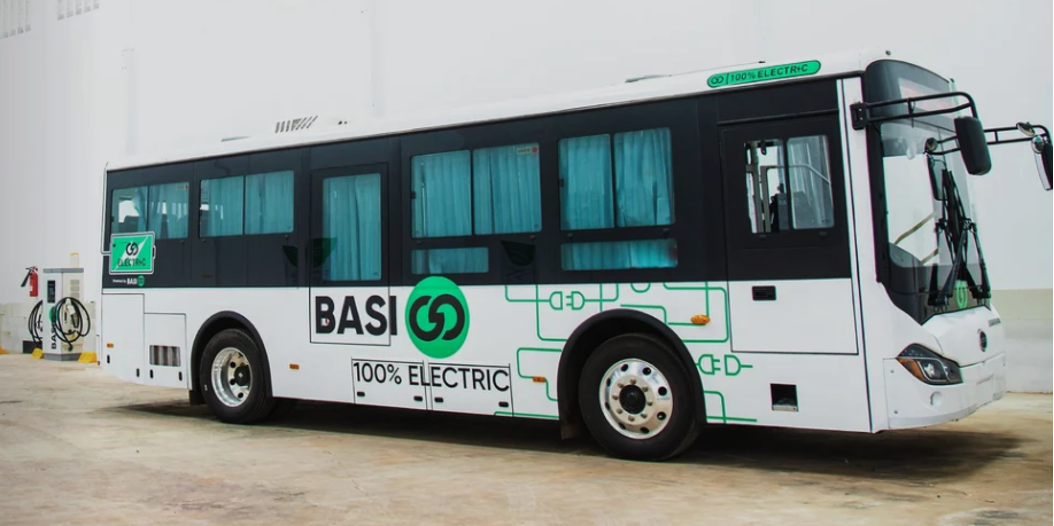
Photo: BasiGo
Kenya is accelerating the drive to zero through its National E-Mobility Policy, the country’s first coordinated framework to transition to an advanced technology zero-emission freight sector. The National E-Mobility Policy—headed by Kenya’s Ministry of Roads and Transport—dovetails with the Global Memorandum of Understanding (Global MOU) on Zero-Emission Medium- and Heavy-Duty Vehicles (ZE-MHDVs), which aims for 100% new zero-emission truck and bus sales sales by 2040 with an interim goal of 30% new sales by 2030.
Global MOU endorser, Africa E-Mobility Alliance (AfEMA) explains why Kenya is ready for the transition now. In a new article and with the support of Drive to Zero and our Zero-Emission Technology Inventory (ZETI) tool, AfEMA reports that the number of ZE-MHDV models available for purchase in Kenya “has expanded steadily since 2022” and there are now 160 zero-emission buses and mini buses registered in the country.
AfEMA’s conclusion? Kenya is ready for large-scale deployment of EV technology across freight and passenger transport because they are both technically and strategically viable.
Read AfEMA’s article here to find out what can accelerate the transition even faster for Kenya. Want to know what models are available today in Kenya? Check out ZETI.
🔌 Global MOU Community Spotlight: CHARGE
CHARGE is poised to play a key role in powering South Africa’s transition to ZE-MHDVs. Recognizing that the country’s grid doesn’t have the strength or capacity to handle additional load growth, CHARGE plans to develop and deploy clean energy microgrids on all national roads that can be used as charging stations for ZE-MHDVs. The company has already completed a project along the Jonannesburg-Durban corridor and has several more sites in the works. Powering ZE-MHDVs with clean energy—that’s changing transportation for good!
Watch this video to learn more:
Upcoming Events
🗓️ Reminder: Register for the Global MOU Forum 2026

✅ Expert workshops
✅ ZET Talks (our version of TED talks)
✅ High-value networking opportunities
✅ A zero-emission truck showcase
Everything about the Global MOU Forum 2026, taking place in Santiago, Chile from September 8-10, is designed to help our Global MOU signatories and endorsers achieve their zero-emission bus and freight goals. Nearly 20 countries have signed up for the Global MOU Forum—have you?
🇨🇱 In the Spotlight: Chile’s Fuel Economy Standards

Interested in learning more about Chile’s transition to clean vehicles ahead of the Global MOU Forum? Our partners at the Center for Sustainable Mobility have you covered!
Chile’s Fuel Economy Standards: Webinar on Opportunities and Progress for the Automotive Market
On Tuesday, August 4th, at 15:00 UTC via Zoom, the Center for Sustainable Mobility will present the key findings of the latest Energy Efficiency Monitoring Report for Light-Duty Vehicles in Chile.
Register for the Online Session
Top Headlines

Market
- Australian-made electric trucks to keep Australia moving
- São Paulo Deploys 500 Electric Buses Simultaneously
Fleet Deployments
- Falcon Buses launches first independent fleet of next-generation Alexander Dennis Enviro200EV electric single-deckers
- Delhi Flags Off 300 E-Buses, Fleet Reaches 4,850
- Wren Kitchens introduces electric HGVs to cut emissions
- Zenobē and Woolworths Drive Australia’s Largest Electric Truck Rollout with Landmark 148-Vehicle Deal
- Lothian enhances customer experience with new electric buses for Service 36
Manufacturers and Models: Trucks and Buses
- MAN advances electrification of inbound logistics
- Long-haul operations now within reach of Renault Trucks electric tractors
- Australia’s first electric articulated bus revealed in Perth
Financial Incentives
Fuels and Infrastructure
- Mars and REWE put 47 electric trucks into operation
- WattEV’s new heavy-duty electric truck charging depot in Fresno is its seventh in California
- CATL partners with J&T Express to provide battery swap services for 5,000 heavy-duty trucks
- Ledermair is electrifying the largest e-bus depot in Tyrol with Kempower and vlotte vkw