
The BC2BC ZEV Corridor initiative will seamlessly power e-trucks on I-5 from Vancouver, British Columbia to Baja California, Mexico
LONG BEACH — California, British Columbia, Oregon, Washington, and Baja California (Mexico) government leaders today announced the creation of an advanced technology zero-emission charging network for e-trucks along the I-5. The coming British Columbia to Baja California ZEV Corridor (BC2BC) will make it possible for electric trucks to charge and drive all the way from Vancouver, British Columbia to Baja California, Mexico. At a high-level ceremony and zero-emission truck showcase at the Port of Long Beach, officials committed to collaboratively harmonizing the technologies along the route as well as the planning to ensure the project’s success.
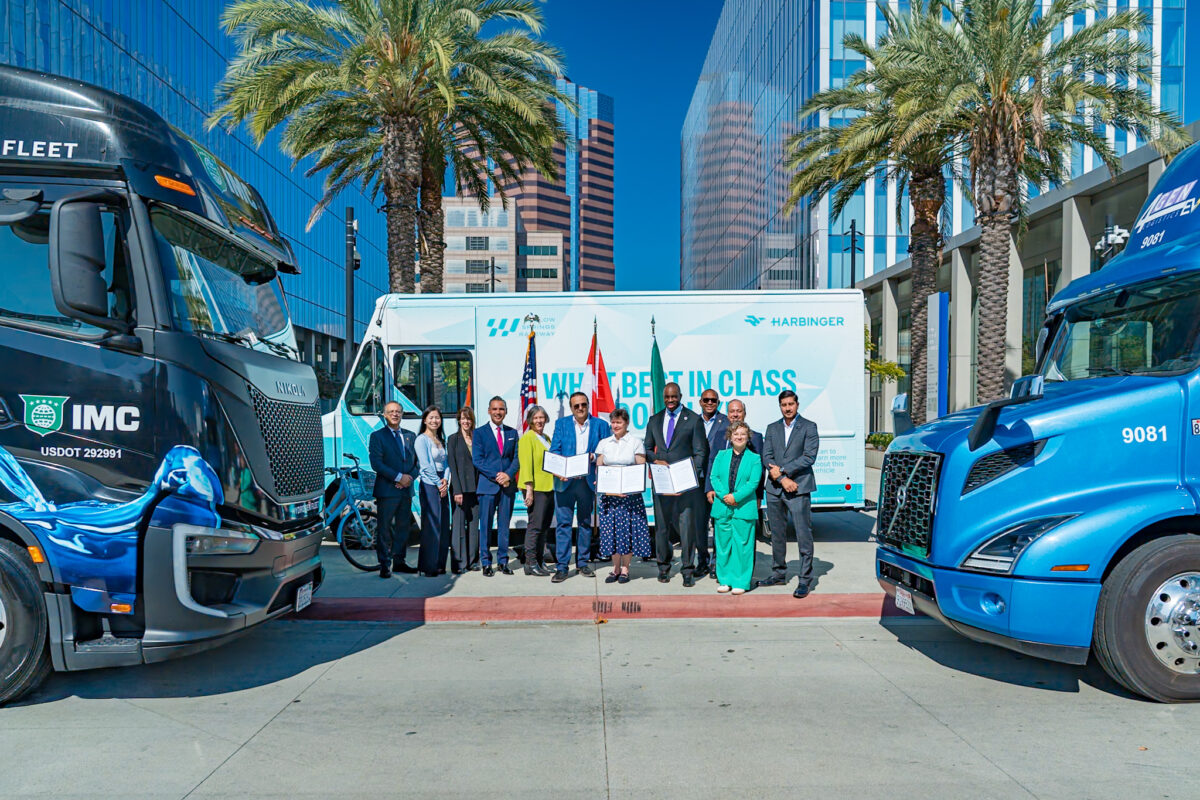
Caption: (L-R) Porfirio Vargas Santiago, Undersecretary, Baja California’s Secretariat of Infrastructure, Urban Development, and Territorial Reorganization (“SIDURT”); Le-Quyen Nguyen, Deputy Executive Director, California Public Utilities Commission; Prof. Alissa Kendall, UC Davis Institute of Transportation Studies; CEO Dr. Noel Hacegaba, Port of Long Beach; Vice President Sharon L. Weissman, Harbor Commission; Director Alberto Gutiérrez Topete, Director General of the Instituto de Movilidad Sustentable (IMOS) in Baja California, Mexico; Secretary Julie Meredith, Washington State Secretary of Transportation; Secretary Toks Omishakin, California State Transportation Agency; Mayor Rex Richardson, City of Long Beach; Michael Berube, CEO, CALSTART; Christine Casey, California State Transportation Agency; Antonio R. Otanez, CEO, ADMICARGA (Baja California’s rail agency). Photo courtesy of Port of Long Beach.
“With global fuel prices driving up the cost of moving goods, partnerships like this are more critical than ever to strengthen our economies and advance Governor Newsom’s zero-emission transportation goals,” said California Transportation Secretary Toks Omishakin. “The BC2BC Corridor is a groundbreaking effort that brings cross-border partners together to build a cleaner, more connected freight network for all.”
Once completed, freight shippers and operators will be able to charge their zero-emissions fleets along the entire West Coast with the initial buildout including 20 electric charging stations and 3 hydrogen stations. Average daily truck traffic on the corridor is nearly 10,000 trucks.
“Freight corridors are where electrification can deliver real operational value at scale. By aligning charging infrastructure, technical standards, and planning across jurisdictions, the BC2BC initiative can give fleets greater confidence to plan routes, maintain uptime, and make long-term investment decisions. For Volvo Group, this collaboration supports our commitment to providing customers not only with zero-tailpipe-emission vehicles, but also with the reliable ecosystem needed to operate them productively,” said Aravind Kailas, Advanced Technology Policy Director, Volvo Group North America.
Volvo Group North America, Southern California Edison, Tesla, EV Realty, and King Fio Trucking participated in the event. Zero-emission trucks from shipper IMC Logistics plus manufacturers Volvo, Tesla, and ZM Trucks—were on display today at the Port of Long Beach as a part of the launch.
The five governments issued a statement of principles on the initiative to ensure alignment and interoperability, while also increasing future returns on investment and maximizing decarbonization benefits. Read the full statement on CalSTA’s website.
“The Port of the Future will need new, innovative technologies, energy sources, and sustainable practices to realize our goals of doubling our annual cargo volume to 20 million containers by 2050 and becoming the first zero-emission port in North America. This agreement is an important step toward decarbonizing goods movement on the West Coast and provides the type of support the industry needs to transition to zero-emission trucks for moving cargo on major transportation routes between Canada and Mexico,” said Dr. Noel Hacegaba, CEO of the Port of Long Beach.
The BC2BC initiative is supported by CalSTA, CALSTART/Drive to Zero, and the Institute of Transportation Studies at the University of California, Davis. The organizations are coordinating planning and investment for the project.
“The technology has arrived, and the BC2BC Corridor proves we can build the cross-border infrastructure network necessary to power at scale. By linking key freight hubs across borders, this initiative creates a high-impact blueprint that other regions can replicate to strengthen supply chains, protect communities, and accelerate their own market transitions,” said Alycia Gilde, Executive Vice President of California and Regional Market Acceleration at CALSTART.
“The UC Davis Institute of Transportation Studies is excited to be a founding partner of BC2BC. This partnership connects world-leading research on freight decarbonization with policymakers and industry to accelerate the transition to zero-emission technologies and demonstrate the power of collaboration across academia, government, and industry to achieve our climate and economic goals,” said Prof. Alissa Kendall, Director of the Institute of Transportation Studies at UC Davis.
Following today’s official launch event, there will be a series of technical meetings among the five states and provinces to coordinate guidance, technical standards, and planning. The BC2BC Corridor builds on California’s work to catalyze United States West Coast zero-emission charging and fueling infrastructure by incorporating international partners across the U.S. border. This project will also complement the next edition of the California-Baja California Border Master Plan project by Caltrans, which will include extensive vehicle decarbonization and zero-emission infrastructure plans that would be drawn from this initiative.
The BC2BC Corridor is a part of the Global Green Road Corridor initiative (GGRC), which is decarbonizing the corridors medium- and heavy-duty vehicles use to move people and the world’s goods from ports to hubs to cities around the globe each day. GGRCs are now in development in Africa, Europe, the Americas, and Asia. This growing infrastructure will help support local economies and societies that rely on freight and transport by ensuring clean, technologically advanced, and abundant charging for e-trucks and e-buses. GGRCs are creating a blueprint for a growing zero-emission truck market and zero-emission freight and transport future that is scalable and can be replicated globally.
Media Contacts:
- CalSTA: media@calsta.ca.gov, 916-323-5400
- CALSTART’s Drive to Zero: Carina Daniels, carina@storyandreach.com, 510-847-1617 (cell)
- Port of Long Beach: Kate Kuykendall, kate.kuykendall@polb.com, 562-751-0024
- UC Davis ITS: Samuel Chiu, sachiu@ucdavis.edu