
Our team has just returned from the 2026 United Nations Climate Change Conference (COP31) in Antalya, Türkiye, where we championed groundbreaking approaches by public- and private-sector leaders to advance zero-emission freight policies and deployment as drivers of climate action and economic growth.
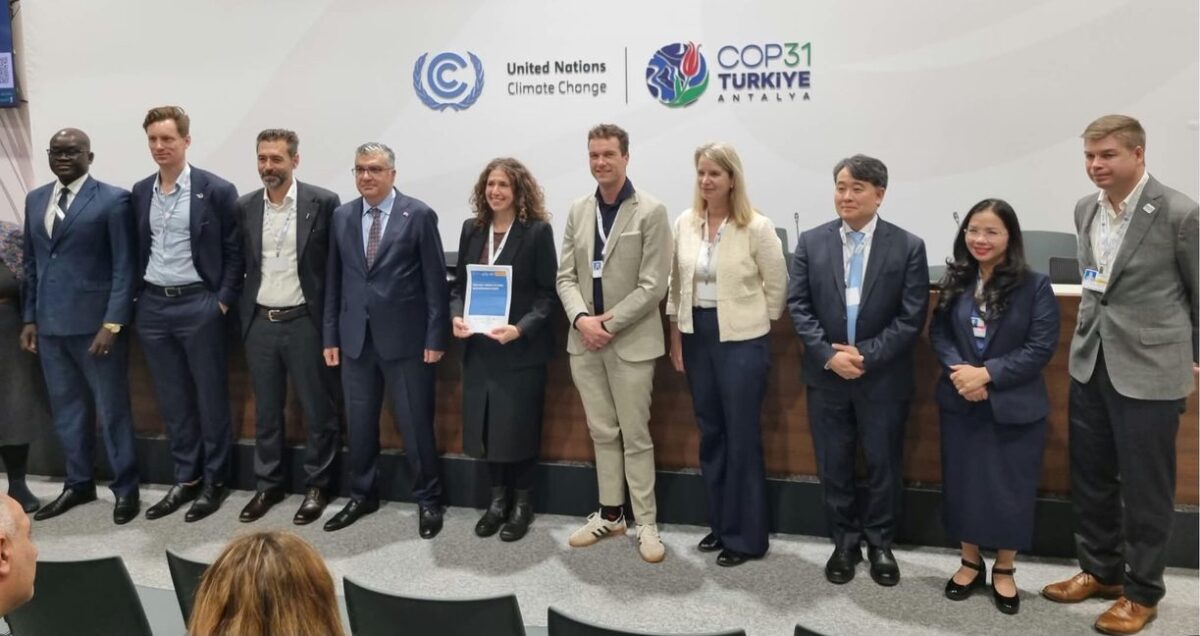
Photo: Featured experts at Catalyst Mobility high-level event “Scaling Global Road Freight Electrification.” L-R: Dr. John Deng Diar Diing, Executive Secretary, Northern Corridor Transit and Transport Coordination Authority | Nicholas Mazzei, DP World | Andreas Foller, TRATON GROUP| Durmuş Ünüvar, Deputy Minister, Ministry of Transport and İnfrastructure Türkiye | Stephanie Kodish, Catalyst Mobility | Rick Arends, Smart Freight Centre | Petrouschka Werther, Director of Sustainable Mobility, Ministry of Infrastructure and Water Management, Netherlands | Eric Kawabata, Amazon | Tim Dallman, ICCT.
The COP31 Presidency issued an ambitious “35 by 35 pledge” to increase electricity’s share of global final energy consumption to 35% by 2035. Electrifying transport while also cutting passenger and freight energy demand is central to achieving this goal. At COP31, we spotlighted why and how zero-emission trucks, buses, and charging infrastructure play a central role in meeting this target—particularly amid a global diesel crisis.
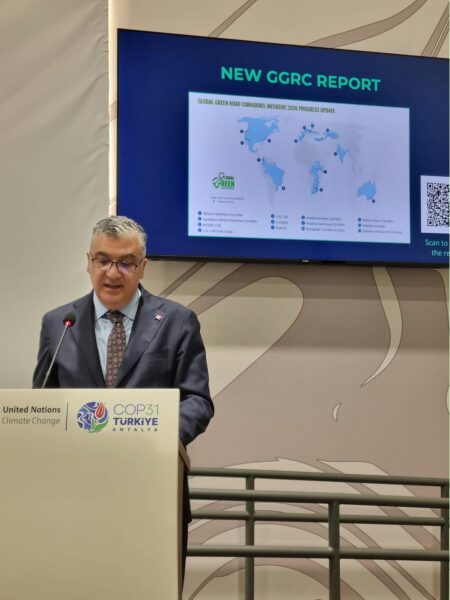
Photo: Durmuş Ünüvar, Deputy Minister, Ministry of Transport and İnfrastructure Türkiye, delivering keynote at Catalyst Mobility high-level COP31 event “Scaling Global Road Freight Electrification.
Throughout COP31, we demonstrated how our growing global network is turning these ambitions into action:
- At our COP31 event, “Convening a Network for Zero-Emission Freight: e-Dutra and the Global MOU,” our partners at the e-Dutra Coalition announced the installation of three new fast-charging hubs for electric trucks along the corridor linking São Paulo and Rio de Janeiro. These hubs will support the coalition’s goal of enabling 1,000 electric truck trips a day by 2030. Read about e-Dutra and other global green corridors we are helping to accelerate in our GGRC Progress Update today!

Photo: Juliana Silva, Director of Sustainability, Motiva, e-Dutra Steering Committee | Jean Benevides, Director, ABDE (National Development Bank Association) and VP of Sustainability and Digital Citizenship, Caixa | Andreas Foller, Chief Sustainability Officer, TRATON, e-Dutra Steering Committee | Lidiane Rocha de Oliveira Melo, Director of the Department of Mitigation Policies and Implementation Instruments (DPMI), of the National Secretariat for Climate Change | Stephanie Kodish, Senior Global Director, Catalyst Mobility at COP31 Catalyst Mobility event “Convening a Network for Zero-Emission Freight: e-Dutra and the Global MOU.
- The Global MOU community continues to grow! With Côte d’Ivoire joining at COP31, our community now includes 44 countries and more than 300 endorsers.
- At our events, we hosted government representatives from Türkiye, Australia, Brazil, Netherlands, and Vietnam as well as leading global brands including Amazon, TRATON GROUP, and DP World!
- At our high-level event, “Scaling Global Road Freight Electrification,” which featured a keynote from Deputy Minister Durmuş Ünüvar of Turkey’s Ministry of Transport and İnfrastructure, experts from all corners of the world, representing the public and private sectors, agreed that e-trucks, e-buses, and charging infrastructure strengthen energy security and industrial competitiveness, especially for fuel-importing economies amid the diesel crisis. The message was clear: Zero-emission trucks are ready; the focus now is on implementation.
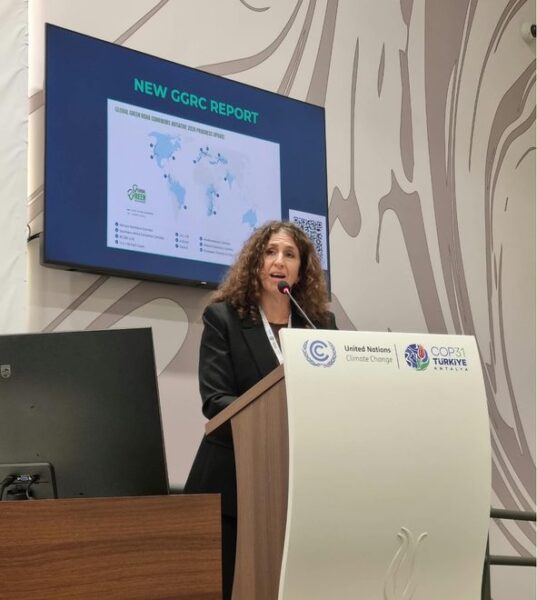
Photo: Stepanie Kodish, Senior Global Director, Catalyst Mobility, at Drive to Zero’s high-level event “Scaling Global Road Freight Electrification” at COP31.
The road to 35 by 35 is electric. Here is how we get there:
- Global Green Road Corridors: aligning vehicles, charging, grid distribution, renewable energy, finance, and policy along strategic routes can help countries meet their Nationally Determined Contributions at scale. By connecting projects into a coordinated system, governments and markets can accelerate individual projects while maximizing their collective global impact.
- The Potsdam Principles on Commercial Fleets: Bring together commercial fleet operators, charging providers, distribution system operators, and utility regulators to support rapid vehicle electrification.
- Supply-side regulation: Provides manufacturers, fleets, charging providers, utilities, and investors with the certainty and market signals they need to commit capital.
Electric trucks reached about nine-percent of global truck sales in 2025. To build on this progress, the focus must shift from individual solutions to coordinated execution bringing together the vehicles, charging, grid capacity, renewable energy, finance, freight demand and enabling policy along strategic freight routes.
We can decarbonize road freight—and we must do it together. Through our global partnerships and coordinated action, we can deliver economic advances, good jobs, healthier air, and a safer environment through zero-emission trucks, buses, and infrastructure.
— Stephanie Kodish, Senior Global Director, Catalyst Mobility’s Drive to Zero
Read more COP31 updates and see our photos here.
Special Features
🌎 Welcome to Our New Global MOU Endorsers
 |
|
Join them — endorse the Global MOU today!
📄 GGRCs—Moving Into The Implementation Phase
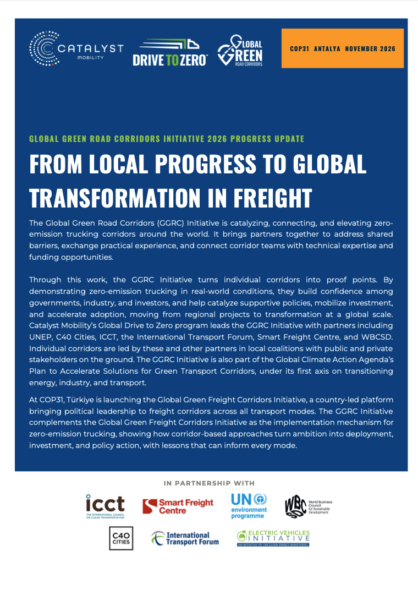
At COP31, we released an exciting progress report on the Global Green Road Corridors Initiative. Of the 13 corridors spanning 31 countries and more than 29,000 km of freight routes, seven have already reached the implementation phase, helping create jobs, drive economic growth, and reduce greenhouse gas emissions.The GGRC Initiative complements the Global Green Freight Corridors Initiative launched by Türkiye at COP31, serving as the implementation mechanism for zero-emission trucking. Explore the corridor close-ups, maps, and lessons in the full report.
🎥 Video: E-Trucks Make History on Brazil’s E-Dutra Corridor
e-Dutra is Brazil’s first zero-emission freight corridor, equipped with charging stations for electric trucks along a 250-mile route connecting the major economic hubs of Rio de Janeiro and São Paulo. In this video, Catalyst Mobility’s Brazil Lead Isabela Barbosa, along with our partners at LOTS Group, Planejamento e Sustentabilidade/VWCO, and Coordenadora Geral de Agenda de Ação/COP 30, offer a firsthand look at how this Global Green Road Corridor is improving the experience for drivers, while mobilizing public and private sector partners to reduce greenhouse gas emissions in line with COP30 climate goals.
🎥 ZET Talk: Building Green Road Corridors Across Africa
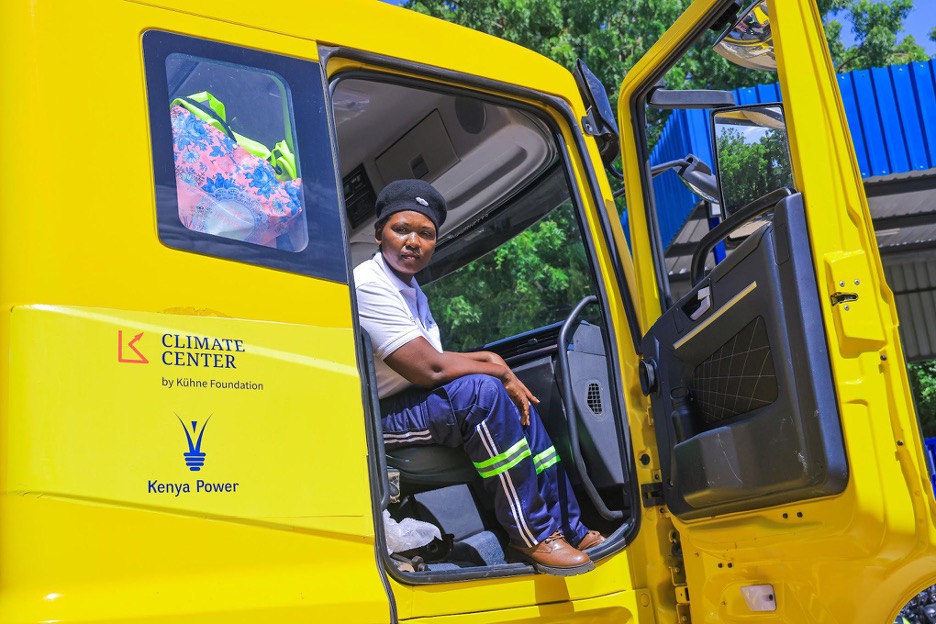
Photo: Getting ready to drive a Kabisa truck 600 miles roundtrip from Nairobi to Mombasa.
The moment is now to electrify Africa’s freight corridors—and electric mobility company Kabisa is leading the charge. During her ZET Talk at the Global MOU Forum, Iliza Karangwa of Kabisa outlined the company’s inspiring 10-year vision to create green road corridors across the continent.
Currently, Africa’s freight corridors, which connect 1.2 billion people, are used by more than 100,000 diesel trucks. Combined, they consume $5 billion in imported fuel annually, creating a high price tag that trickles down in the form of higher costs for businesses, consumers, and the broader economy.
Green road corridors are part of the solution. Over the next 10 years, Kabisa aims to deploy more than 40,000 EV trucks and build 10 electric corridors across Africa. These corridors are expected to reduce carbon emissions by 1 million tons and save countries $1 billion in fuel expenses every year, while helping catalyze the creation of more than 100,000 jobs.
Kabisa is already making progress toward this vision. In just 2.5 years, the company has deployed 15 electric heavy-duty trucks and 30 charging stations across Rwanda, Kenya, and Tanzania, while creating 70 part-time and full-time jobs—already delivering climate and economic benefits for the region.
🇦🇹 Austria—Charging Up Change with the Eurovignette Directive
In 2021, Austria implemented a 75% toll reduction for zero-emission heavy duty vehicles. In response to positive feedback from transport and logistics companies interested in electrifying their fleets, Austria extended the reduction by five years, from 2025 to 2030.
Silvia Haas-Memedovic from the Federal Ministry Innovation, Mobility, Infrastructure Republic of Austria shares more details in the video clip below from our recent virtual event, Eurovignette in Action.
Top Headlines

Market
Fleet Deployments
- Zenobē extends partnership with Transport UK
- Perth’s largest electric bus depot opens with charging for 132 buses
- Einride and Lorenz Bring Autonomous Fleet to Production Facility in Germany
- JBM establishes Asia-Pacific headquarters in Singapore and displays Ecolife e12 e-bus at SUMW
- Quehenberger Logistics is pushing ahead with a major expansion of its electric truck fleet
- Miele Orders 840 Volkswagen Electric Vans For European Service Fleet
Manufacturers and Models: Trucks and Buses
- Daimler Buses continues to rely on Europe for next-generation electric city bus
- Kia launches two new PV5 electric van variants in the UK
- Ebusco secures EUR 12 million in equity commitments, strengthening its financial position and supporting execution of its order book
- MAN Begins Passenger Trials of 12-Metre Autonomous Electric Bus in Munich
- BYD has unveiled the C12 DUO, its new electric coach
- dnata advances fleet modernisation in Italy with four new electric buses
Financial Incentives
- California reopens $55m ZESBI round for electric school buses
- Illinois EPA Launches Clean Trucks Program
Fuels and Infrastructure
- BAIC FOTON Releases Full-Domain Super-Fast-Charging Strategy, Accelerating the Construction of a Global Smart Energy Ecosystem
- Plugit Reports Finland’s First Public MCS Charging Session with Volvo Electric Truck